
New: VEDVERA by ITSECOPS
Run your HIPAA programme inside your own Microsoft 365 tenant. VEDVERA seeds Security Rule safeguards, BAA inventory and ePHI audit log reviews, with no third-party SaaS and no per-user fees.
See the VEDVERA platform · What VEDVERA seeds · 3 year GRC cost calculator
HIPAA compliance means implementing the Security Rule safeguards (45 CFR §164.308, §164.310, §164.312), the Privacy Rule (§164.500 to 534) and the Breach Notification Rule (§164.400 to 414), proving it with a current risk analysis, signed BAAs and training records, and keeping that evidence fresh year round. For a covered entity or business associate with 25 to 500 staff, a credible programme takes 90 to 150 days to stand up and is far cheaper than one enforcement action: OCR civil money penalties run from about $140 per violation at the lowest tier to more than $2.1 million per year per violation category at the top tier, adjusted annually for inflation.
Enforcement is not theoretical in 2026. OCR’s Risk Analysis Initiative has produced a steady run of settlements since late 2024, and the finding behind most of them is the same: no current, organization-wide risk analysis. That is also the first question in the gap check below.
HIPAA in 2026, the numbers that matter to an organization
- Who must comply: covered entities (providers, health plans, clearinghouses) and every business associate that touches PHI, healthcare SaaS included.
- Breach notification deadline: affected individuals and HHS within 60 days of discovery, media for breaches of 500+ records in a state.
- Audit log retention: HIPAA documentation must be kept 6 years.
- Top OCR finding: missing or stale risk analysis (§164.308(a)(1)(ii)(A)).
- Typical readiness timeline: 90 to 150 days for a 25 to 500 person organization with focused ownership.
HIPAA gap analysis: 12 questions, your score on screen
Answer the 12 questions an OCR investigator or a customer security review would ask first. Your readiness score and top gaps appear on this page instantly. Unlock the full result and you get your personalized HIPAA compliance roadmap: your gaps sequenced into dated phases with owners, built from your answers, which no generic checklist on the internet can give you.
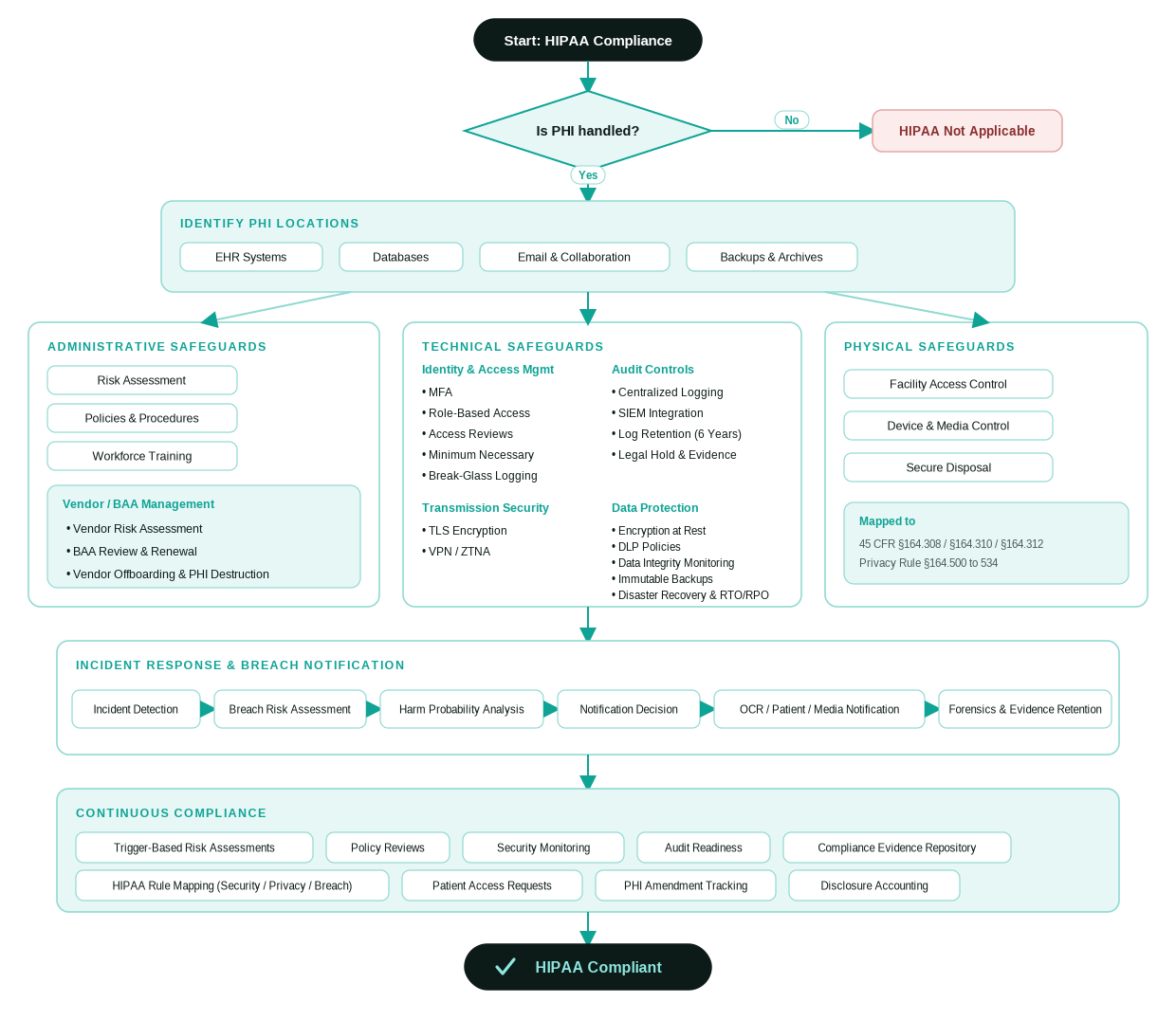
The HIPAA compliance roadmap, end to end
This is the operating map we use with covered entities and business associates. Every box is a control an assessor, an insurer or a customer security questionnaire can ask you to evidence.
Phase 1, days 1 to 30: risk analysis and quick wins
Inventory every system, vendor and workflow that stores, processes or transmits PHI (EHR, databases, email and collaboration, backups and archives). Run the organization-wide risk analysis against §164.308(a)(1) and open a risk management plan with an owner and a date per risk. Turn on MFA everywhere ePHI lives. This phase alone removes OCR’s most common finding.
Phase 2, days 31 to 60: administrative safeguards and vendors
Approve the policy set (not toolkit PDFs nobody has opened), run workforce training with completion records, and close the BAA loop: a signed agreement with every vendor touching PHI, a vendor risk assessment, and an offboarding step that includes PHI destruction.
Phase 3, days 61 to 90: technical safeguards
Role-based access with documented reviews, minimum necessary enforcement, break-glass access logging, centralized audit logs retained 6 years with SIEM review, TLS in transit and encryption at rest, DLP, immutable backups and a tested disaster recovery plan with defined RTO and RPO.
Phase 4, days 91 to 120: physical safeguards and breach readiness
Facility access control, device and media inventory, secure disposal. Then rehearse the breach path: detection, breach risk assessment, harm probability analysis, the notification decision, and OCR, patient and media notification inside the 60 day window, with forensics evidence retained.
Phase 5, ongoing: continuous compliance
Trigger-based risk assessments, annual policy reviews and training, security monitoring, an evidence repository mapped to the Security, Privacy and Breach Rules, and the patient rights workflows: access requests inside 30 days, amendment tracking, disclosure accounting.
Who owns what: the accountability table
| Control area | Rule | Typical owner | Evidence an auditor asks for |
|---|---|---|---|
| Risk analysis and risk management | §164.308(a)(1) | Security officer / CISO | Dated risk analysis, risk register with owners |
| Policies and training | §164.308(a)(5) | Compliance / HR | Approved policies, completion records |
| BAAs and vendors | §164.308(b) | Compliance / procurement | Signed BAAs, vendor inventory |
| Access, logging, encryption | §164.312 | IT / security engineering | MFA policy, access reviews, log retention |
| Facilities and devices | §164.310 | IT / office operations | Device inventory, disposal records |
| Breach notification | §164.400 to 414 | Security officer + legal | IR plan, breach risk assessment template |
| Patient rights | §164.500 to 534 | Privacy officer | Access request log, disclosure accounting |
What HIPAA compliance costs in 2026
Market ranges for a 25 to 500 person organization: a professional risk analysis typically runs $2,500 to $15,000, policy and training programmes $3,000 to $12,000, and technical remediation varies with your stack. ITSECOPS delivers HIPAA readiness at a fixed fee with the risk analysis, policies, training, BAA inventory and evidence filed for you, and the 24×7 SOC covers the monitoring controls from $300 per month for up to 25 endpoints. The exact figure for your size arrives in writing within one business day from the gap tool above, no call unless you ask.
Proof it works: a Florida healthtech ran HIPAA and SOC 2 on one control set and secured its insurance renewal. Related: compliance readiness consulting, virtual CISO, shared 24×7 SOC.
Penalties and enforcement: what non-compliance costs
OCR civil money penalties are tiered by culpability, from about $140 per violation where the entity did not know and could not reasonably have known, to more than $2.1 million per year per violation category for uncorrected willful neglect, with figures adjusted annually for inflation. State attorneys general can bring their own actions, and a breach also triggers notification costs, forensics, credit monitoring and customer attrition that routinely dwarf the fine. OCR’s Risk Analysis Initiative settlements since late 2024 show the fastest way onto that list is skipping question 1 of the gap check above.
HIPAA compliance questions organizations actually ask
Is my company a business associate?
If you create, receive, maintain or transmit PHI for a covered entity, yes: healthcare SaaS, billing firms, IT providers, cloud hosts and analytics vendors included. You need a signed BAA and the full Security Rule programme.
How long does HIPAA compliance take?
90 to 150 days for a 25 to 500 person organization with a named owner: risk analysis in the first 30 days, administrative safeguards and BAAs by day 60, technical safeguards by day 90, breach readiness by day 120, then continuous compliance.
Is there an official HIPAA certification?
No. HHS certifies nobody. Compliance is demonstrated with evidence: a current risk analysis, policies, training records, BAAs and audit logs. Third-party attestations help in sales but do not replace that evidence.
What does OCR check first in an investigation?
The risk analysis, its date and its scope. Then the risk management plan, training records, BAAs and audit logs for the systems involved in the complaint or breach.
Does HIPAA require encryption?
Encryption is an addressable specification: you either implement it or document why an equivalent alternative is reasonable. In practice, unencrypted laptops and drives are behind many settlements, so treat encryption at rest and in transit as required.
How fast must we report a breach?
Affected individuals and HHS within 60 days of discovery; immediately practicable for larger incidents, and media notification when 500 or more residents of a state are affected. Your breach risk assessment decides whether an incident is a reportable breach, which is why the process must exist before the incident.
Can we run HIPAA compliance without new software?
Yes. The evidence can live in your Microsoft 365 tenant: that is exactly what VEDVERA does, seeding Security Rule safeguards, the BAA inventory and audit log review duties with no third-party SaaS and no per-user fees.
What should we do first, today?
Run the 12-question gap analysis above. It scores you against the items OCR checks first and sequences your gaps into a dated roadmap you can hand to your team on Monday.